
We like to think that modern science and archaeology have mapped out every corner of human history. But the truth is, the past is full of deep, frustrating silences. Across the globe, there are artifacts, events, and civilizations that defy explanation, leaving historians with far more questions than answers.
Here are seven historical mysteries that continue to baffle researchers and spark endless debate.
1. The Voynich Manuscript
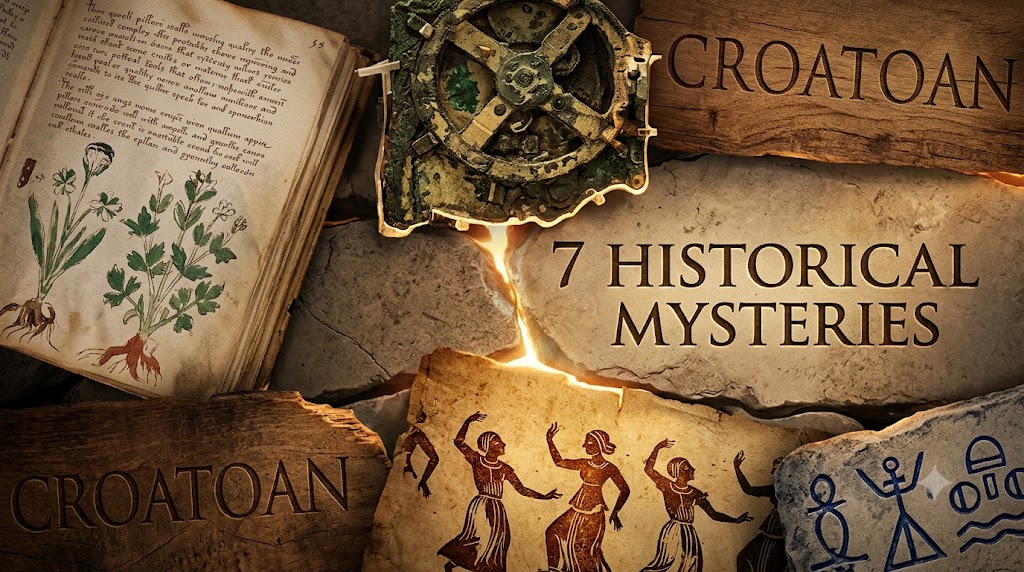
Written in the 15th century, this illustrated codex is hand-written in an entirely unknown writing system. Its pages are filled with bizarre drawings of imaginary plants, astrological diagrams, and nude figures bathing in strange green pools. Despite being studied by top codebreakers from World War I and II, no one has managed to decode a single sentence. Is it an elaborate medical guide, an early cipher, or the most successful hoax in history?
2. The Lost Colony of Roanoke
In 1587, 115 English settlers established a colony on Roanoke Island, off the coast of modern-day North Carolina. Three years later, a supply ship returned to find the settlement completely abandoned. There was no sign of a struggle or battle. The only clue was a single word carved into a wooden post: “CROATOAN.” To this day, the ultimate fate of the settlers remains shrouded in speculation.
3. The Antikythera Mechanism
Discovered in a shipwreck off the Greek island of Antikythera in 1901, this corroded bronze device is essentially a 2,000-year-old analog computer. Using a complex system of dozens of interlocking gears, it could predict astronomical positions and eclipses decades in advance. The mystery? Technology of this sophistication didn’t reappear in human history for another thousand years. How did the ancient Greeks build it, and why did the knowledge disappear?
4. The Dancing Plague of 1518
In July 1518, a woman named Frau Troffea stepped into a street in Strasbourg, France, and began to dance fervently. Within a month, around 400 people had joined her, dancing uncontrollably for days without rest. Many literally danced themselves to death from strokes, heart attacks, or exhaustion. No one has ever proven what caused this bizarre mass hysteria.
5. The Sea Peoples
During the Late Bronze Age, a highly advanced network of Mediterranean civilizations (including the Egyptians, Hittites, and Mycenaeans) collapsed in spectacular fashion. Historical records from the era frequently blame a mysterious, terrifying confederation of seafaring raiders known simply as the “Sea Peoples.” Despite their massive historical impact, we still have almost no idea who they were, where they came from, or where they went after their path of destruction.
6. The Gobekli Tepe Paradox
Located in modern-day Turkey, Gobekli Tepe is a massive temple complex featuring towering, intricately carved stone pillars dating back over 11,000 years. What keeps archaeologists awake is that this monument was built before agriculture, pottery, or metal tools. According to conventional history, hunter-gatherers shouldn’t have had the social organization, division of labor, or engineering skills required to build something of this scale. It completely rewrites the timeline of human civilization.
7. The Death of Alexander the Great
In 323 BC, at the absolute height of his power, 32-year-old Alexander the Great suddenly fell ill and died in Babylon after two weeks of fever and agonizing abdominal pain. For over two millennia, historians have debated the cause. Was it malaria, typhoid fever, pancreatitis, or was he poisoned by one of his ambitious generals? With his tomb still undiscovered, we may never know the truth.