
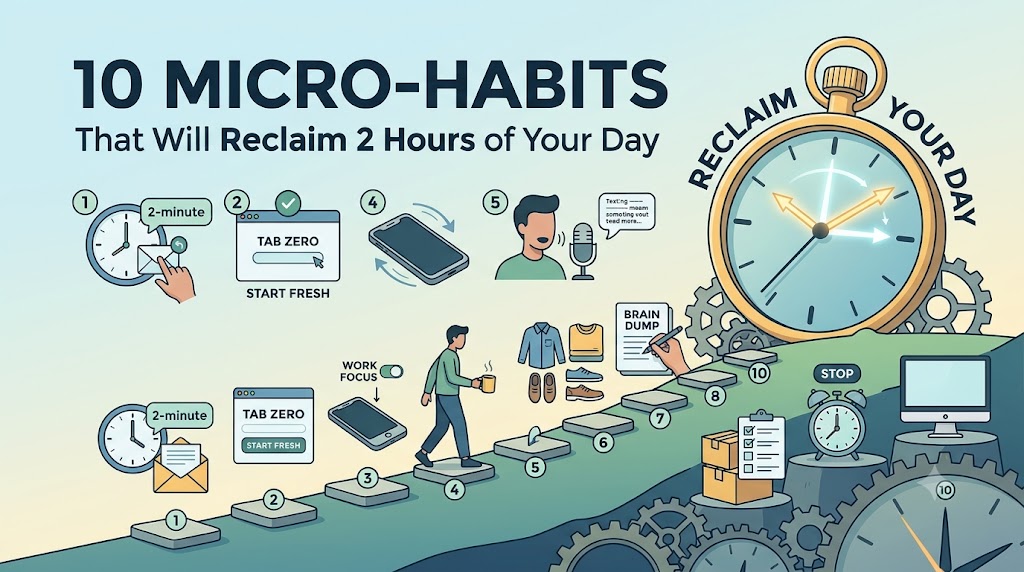
We all get the same 24 hours, but it often feels like time is slipping through our fingers. Between endless notifications, scattered focus, and daily friction, it’s easy to lose hours to nothing in particular.
You don’t need a massive lifestyle overhaul to win your time back. By implementing these 10 micro-habits—actions that take less than two minutes to start—you can easily reclaim up to two hours of your day.
1. The 2-Minute Reply Rule
The Habit: If an email, text, or task takes less than two minutes to finish, do it immediately instead of putting it off.
Why it saves time: It eliminates the mental drag of “double-handling” information. You waste more time reading a message, closing it, remembering it later, and re-reading it than you do just handling it right away.
Estimated savings: 15 minutes/day
2. Tab Zero Before Leaving Your Desk
The Habit: Close every single browser tab at the end of your workday, leaving only a blank screen or your calendar for the next morning.
Why it saves time: When you open your laptop the next day, you aren’t sucked into yesterday’s digital clutter. You start fresh, focusing entirely on your top priority instead of getting sidetracked by old articles or half-finished tasks.
Estimated savings: 10 minutes/day
3. The “Do Not Disturb” Default
The Habit: Flip your phone face down and switch on a custom “Work Focus” mode whenever you sit down to complete a task.
Why it saves time: Every time your phone lights up, it takes an average of 23 minutes to refocus on your original task. Eliminating visual and audio pings keeps you in a flow state, allowing you to finish work twice as fast.
Estimated savings: 25 minutes/day
4. Close the Loop on Your Way Out
The Habit: Never leave a room empty-handed. If you are walking from the living room to the kitchen, grab that coffee mug. Moving from your desk? Take the trash with you.
Why it saves time: It stops mess from accumulating. By integrating tidying into your natural movements, you completely eliminate the need for a massive, time-consuming cleanup session at the end of the week.
Estimated savings: 10 minutes/day
5. Dictate Your Drafts
The Habit: Use the voice-to-text feature on your phone or computer to outline emails, texts, or notes while you walk or stretch.
Why it saves time: Most people speak at roughly 130–150 words per minute, but type at only 40 words per minute. Speaking your thoughts aloud gets the ideas down instantly, leaving you with only quick edits to make.
Estimated savings: 15 minutes/day
6. Lay Out Tomorrow’s Uniform
The Habit: Spend 60 seconds before bed picking out your clothes for the next day, right down to the shoes and socks.
Why it saves time: It eliminates “decision fatigue” first thing in the morning. Instead of staring blankly into your closet while the clock ticks, you can get dressed on autopilot and get moving.
Estimated savings: 10 minutes/day
7. The 5-Minute “Brain Dump”
The Habit: Before you start working, grab a piece of paper and write down everything swirling in your head—errands, worries, ideas—then set it aside.
Why it saves time: An anxious mind is an inefficient mind. Clearing your mental desktop prevents you from stopping mid-task because you suddenly remembered you need to buy milk.
Estimated savings: 15 minutes/day
8. Batch Your Logistics
The Habit: Group all small, administrative tasks (paying a bill, checking shipping status, updating software) into one 15-minute block in the afternoon.
Why it saves time: Context-switching is a massive time killer. Doing these tasks one by one throughout the day fractures your focus. Batching them gets them done in a fraction of the time.
Estimated savings: 10 minutes/day
9. Set a “Hard Stop” Alarm
The Habit: Set an alarm for 15 minutes before your meeting or the end of your workday to signal that it’s time to wind down.
Why it saves time: Without a hard stop, tasks naturally expand to fill whatever time we give them (a concept known as Parkinson’s Law). A ticking clock forces you to stop overthinking and wrap things up.
Estimated savings: 10 minutes/day
10. Clear Your Desktop Every Friday
The Habit: Before logging off for the weekend, delete or archive every stray file cluttering your computer desktop.
Why it saves time: Visual clutter creates cognitive friction. Starting your week with a clean digital workspace allows you to dive straight into high-value work on Monday morning without spending time sorting through files.
Estimated savings: 10 minutes/day
The Bottom Line
Small changes compound quickly. You don’t need to implement all 10 of these micro-habits today. Pick two or three that resonate with you, practice them until they become automatic, and watch your free time start to open up.
Which micro-habit are you going to try first? Let me know in the comments below!